Patio Subsidence in Sheffield and Rotherham: Why Indian Sandstone Sinks Without Proper Base Preparation
Patio sinking in Sheffield or South Yorkshire? We explain why subsidence happens, what proper repairs look like, and how to get a lasting fix.

Why Patios Sink: The Real Cause of Patio Subsidence in Sheffield and South Yorkshire
A sunken slab is rarely just bad luck. In most cases we see across Sheffield, Barnsley, Rotherham and the surrounding villages, the root cause is the same: the sub-base underneath was never right to begin with, or something has changed in the ground since the patio was first laid.
Sheffield sits on a mix of geology, from sandstone and clay to made ground in older residential areas. Clay shrinks in dry summers and swells again in wet winters. That constant movement, repeated year after year, works away at any base that was laid too thin, compacted too lightly or skipped altogether. Add South Yorkshire's reliable wet winters into the mix and you have a recipe for slabs that gradually tip, drop or crack.
That is patio subsidence in plain terms: the ground beneath the paving moves, and the slabs follow it.
The Most Common Causes We Find on Sheffield and Barnsley Patios
Every job is different, but these are the causes that come up again and again when we lift slabs and look at what is underneath:
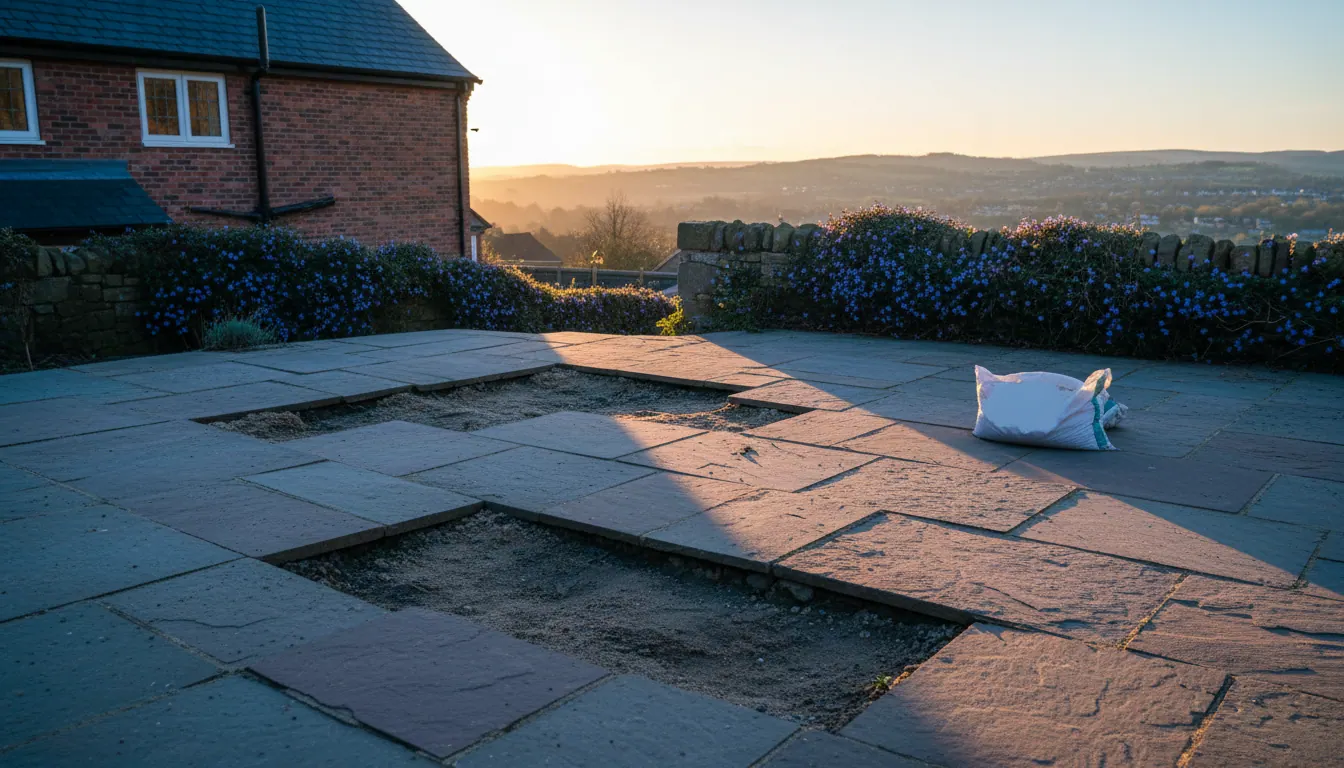
- Inadequate sub-base. The most frequent culprit by far. A proper sub-base means compacted hardcore or MOT Type 1 to the right depth, then sharp sand or a mortar bed on top. We regularly find patios that were laid directly onto soft topsoil, or with a sub-base so thin it offered no real support.
- Tree and shrub roots. This is a big one in older South Yorkshire streets and gardens. Roots from mature trees, especially in areas like Broomhill, Nether Edge, Wombwell or Hoyland where Victorian and Edwardian housing stock comes with well-established gardens, grow under paving and either push slabs up or, when the tree is removed, leave voids that collapse.
- Poor drainage and water pooling. When a patio was laid without the correct falls (a slight gradient away from the house), water sits on the surface and finds its way down through the joints. Over time it washes out the bedding layer and creates hollow spots beneath the slabs.
- Leaking pipes or drainage. A slow leak from a buried drain or water pipe can erode the sub-base material over months without any visible sign above ground, until a slab suddenly drops.
- Made ground and backfill. Particularly relevant in parts of Rotherham, Barnsley and some Sheffield suburbs where old industrial land or demolished outbuildings were filled and built over. Made ground settles unevenly, sometimes for years.
Does Subsidence Ever Completely Stop?
This is one of the most common questions we hear from homeowners who have noticed movement in their patio. The honest answer is: it depends on the cause.
If the movement is driven by clay shrinkage and swelling with the seasons, it will carry on indefinitely. Clay does not stop being clay. A patio laid over an unimproved clay sub-base in Sheffield will continue to move with every dry summer and wet winter until the sub-base is replaced properly.
If the cause was a one-off event, such as a drain that has since been repaired, or a tree that has been removed and the roots have fully broken down, then yes, movement can stabilise. But roots can take years to decompose fully, and the voids they leave behind need filling before you re-lay anything.
The short answer for most homeowners: do not just re-bed the slab on top of a failing base. It will sink again. The fix has to start at the bottom.
Can Patio Subsidence Be Fixed Without Digging Everything Up?
Sometimes, but not always. We will always be straight with you about what is actually needed.
If only one or two slabs have moved and the sub-base around them is solid, it is often possible to lift those specific slabs, address the void or bedding failure underneath, re-compact and re-lay. That is a targeted repair rather than a full dig-out.
But if the sub-base has failed across a wider area, or if the original base was simply never adequate, lifting and re-bedding individual slabs is a short-term fix at best. The surrounding slabs will follow. In those cases the right approach is to take up the affected area, dig out to the correct depth, lay and compact a proper sub-base, and re-lay the paving with the right bedding and falls.
We know that is more work and a bigger disruption. But a patio that is done properly should last for many years without dropping again. One that is patched over a bad base will be back to square one inside a season or two.
What a Proper Patio Repair Looks Like (and What We Actually Do)
When we take on a patio repair or full re-lay in Sheffield, Barnsley or anywhere across South Yorkshire, the process is the same whether it is a small terraced yard in Darfield or a large rear garden in Penistone:
- Lift the affected slabs carefully, keeping as many as possible intact if they are being re-used, or setting new ones aside ready.
- Dig out to the correct depth for the size and weight of paving being used. For Indian sandstone or large-format porcelain, this means enough depth for a solid hardcore base, compacted in layers.
- Compact the sub-base properly. This is where shortcuts get taken on cheaper jobs. Compaction cannot be skipped or rushed.
- Check and correct the falls. Water must be directed away from the house and towards drainage. We set the levels at this stage, not as an afterthought.
- Lay the paving on a full mortar bed rather than the five-dot method, which leaves voids under the slab and causes hollow spots and cracking.
- Point the joints to prevent water getting back in and washing out the bedding.
The same principles apply whether we are laying Indian sandstone, natural stone or porcelain paving. We cover all of these across Sheffield and Barnsley.
What Julie's Experience Shows About Getting the Job Done Right
We hear this a lot: a homeowner trusts us with one job, sees it done properly, and then asks us back for something else entirely.
"Paul and Malc made a beautiful job of our bathroom so we had them back to sort out our garden, we are so pleased with the work they have done for us. Fantastic guys, with excellent communication, would highly recommend!!!!"
Julie Warriner
Julie's garden came after her bathroom, and that pattern is common. When the prep is done properly and the finish is right, people feel confident bringing us back. Whether it is a bathroom strip-out or a patio that needs doing from scratch, the approach is the same: do it right, communicate clearly, leave the place tidy.
Garden Subsidence Beyond the Patio: What Else to Watch For
Patio slabs are usually the first thing homeowners notice, but garden subsidence can affect other structures too. Steps that were once level start to tilt. Retaining walls built from sleepers or brick begin to lean as the ground shifts beneath them. Fencing posts that were set in soft ground work loose over time.
We deal with all of these across South Yorkshire. Sleeper raised beds and terracing on sloping plots, in particular, need to be built with the ground movement in mind, not just set in and hoped for. If you have a sloped garden in Hoyland, Dodworth or on the hillier edges of Sheffield, the landscaping has to account for drainage and load from the outset.
Frequently Asked Questions About Patio Subsidence in Sheffield
Why does my patio keep sinking even after it's been re-laid? Almost always because the sub-base was not addressed. Re-bedding slabs on top of a failed or inadequate base will produce the same result. The fix has to start with the ground underneath, not the surface on top.
Does patio subsidence ever completely stop on its own? If the cause is seasonal clay movement, no. Clay in South Yorkshire will keep shrinking and swelling with the weather. If the cause was a one-off event like a root or a leaking pipe that has been dealt with, movement can stabilise, but the voids left behind still need to be filled and compacted before re-laying.
Can subsidence be fixed without underpinning or a full dig-out? For patios, yes, in some cases. If the failure is localised and the surrounding base is sound, targeted repairs are possible. If the base has failed across a wider area, a proper dig-out and re-lay is the only lasting fix. We will tell you honestly which applies to your job after we have had a look.
We've got tree roots under our paving in Sheffield. What should we do? Roots that are still active will keep moving the slabs. If the tree is staying, the paving needs to be designed around it with root barriers and expansion space. If the tree is coming out, the roots need time to break down and the voids need to be filled and compacted before any new paving goes down. We can advise on the best approach for your specific situation.
Get in Touch for a Free Look at Your Patio
Between us, Paul and Malcolm bring over 60 years of hands-on experience in the building trade, covering everything from full garden transformations to targeted patio repairs across Sheffield, Barnsley, Rotherham, Wombwell, Hoyland, Penistone, Dodworth, Darfield and the surrounding villages. No job is too small.
If your patio is sinking, cracking or draining badly, we are happy to come and have a look, give you an honest assessment and quote the job properly. No obligation, no pressure.
You can find out more about what we do and get in touch at pm-homeimprovements.co.uk.