Lowering Ceilings for Spotlights in Bathrooms: Why It Matters in Older Homes Across Barnsley and Rotherham
Planning bathroom ceiling spotlights in Barnsley or Rotherham? Here's what IP ratings, zone rules and correct prep really mean for a safe, lasting result.
Why Bathroom Ceiling Spotlights Are More Complicated Than They Look
Most people choose their bathroom spotlights from a catalogue and assume they just get wired in. The reality is a little more involved than that. Get the prep wrong, skip the right IP rating, or fit them into a ceiling that hasn't been properly boarded and you end up with either a safety risk or a ceiling that lets cold air and moisture move freely above the fitting. Neither is what you want in a room that runs hot showers every day.
We fit ceiling spotlights in bathrooms right across Barnsley, Rotherham and South Yorkshire as a standard part of our bathroom renovations, and this article runs through exactly what good installation looks like, what the building regulations actually require, and why the order of works matters as much as the fittings themselves.
IP Ratings and Bathroom Zones: What the Rules Actually Mean
The UK wiring regulations (BS 7671) divide a bathroom into zones based on proximity to water. The zones determine the minimum IP (Ingress Protection) rating a fitting must carry.
Here is the short version:
- Zone 0 is inside the bath or shower tray itself. Fittings must be IP67 or above and rated for 12V only.
- Zone 1 is directly above the bath or shower, up to 2.25 metres from the floor. Fittings must be at least IP45.
- Zone 2 is the area within 0.6 metres outside the bath or shower rim, and up to 2.25 metres high. IP44 is the minimum.
- Outside the zones (the rest of the ceiling) standard fittings can be used, but in practice we almost always recommend IP44 or above throughout a bathroom ceiling. Condensation travels.
This is not just box-ticking. A fitting with the wrong IP rating can allow moisture to reach the lamp holder or the wiring over time. In a room where the ceiling is warm and wet air rises every morning, that matters.
Why We Lower the Ceiling Before We Fit the Spotlights
On most of our bathroom renovations, we lower the ceiling slightly and board it out with moisture-resistant plasterboard before anything else goes in. This is standard practice for us and there are a few good reasons for it.
First, it gives us a clean, flat surface to work with. Old bathroom ceilings in South Yorkshire's Victorian and Edwardian terraces, the kind you find all over Rotherham, Wombwell and Barnsley's older streets, are often uneven, cracked or coated in Artex. Skimming over Artex can be done (we cover that in our article on plastering over Artex in Sheffield), but in a bathroom that is being fully stripped, boarding out is usually the cleaner solution.
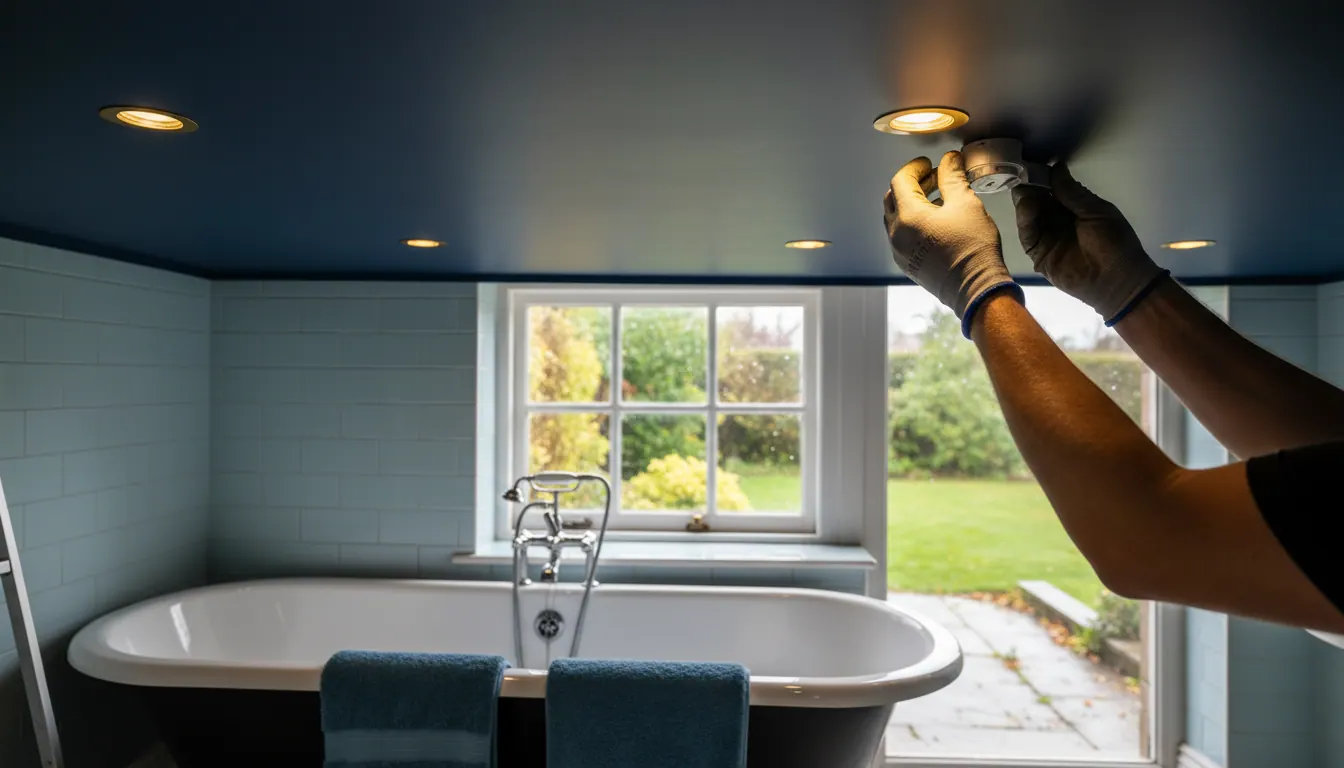
Second, a lowered ceiling creates a void above the board. That void is where the spotlight canisters sit. The canister needs to be fire-rated, and it needs to be installed so that it doesn't create a gap that allows air movement between the room and the void above. Cheap, unrated downlights punched into plasterboard without a fire hood effectively create a hole in your ceiling. In a terrace or semi, that matters for both safety and heat retention.
Third, it allows us to position the spotlights properly. Spacing matters. Too close together and the ceiling looks cluttered; too far apart and you get dark patches. We plan the layout before the board goes up so the fittings land exactly where they should.
The Right Order of Works: Ceiling Before Tiling, Always
This is the part that catches people out when they try to manage trades separately. The ceiling work comes first. Here is why.
If you tile the walls before the ceiling is boarded and plastered, you risk cracking or chipping the top row of tiles when the board is cut and fitted. Plaster dust and debris will also fall onto any finished surfaces below. We always work top to bottom: ceiling first, then walls, then floor.
The same logic applies to the spotlights themselves. We run the first-fix wiring before the board goes up, so the cables drop through exactly where the fittings will sit. Once the board is on, the skim goes over it, and the spotlights are second-fixed after the room is tiled and decorated. That way there is no risk of grout or adhesive fouling the fittings, and no need to work around finished walls.
If you are reading this while planning a full bathroom renovation and wondering how all the trades fit together, our article on plastering a full bathroom in Barnsley goes through the full sequence in detail.
Fire Hoods and Insulation Displacement: The Detail Most People Miss
Every recessed spotlight in a ceiling creates a potential weak point in the thermal and fire envelope of the building. A fire-rated downlight hood placed over the canister from above solves both problems at once: it contains a fire within the void for long enough to matter, and it stops insulation being pushed aside by the heat from the fitting.
In bathrooms above a ground floor, there is often insulation in the ceiling void, or there should be. Without a hood, that insulation has to be kept clear of the lamp to prevent overheating, which means a cold gap directly above each fitting. In a South Yorkshire winter, that gap is felt.
We fit fire-rated hoods as standard. It is not an optional extra.
What a Good Bathroom Ceiling Looks Like When It's Done
Once the board is up, skimmed, and the spotlights are second-fixed, the ceiling should look clean and deliberate. The fittings should sit flush with the surface, not proud or recessed unevenly. There should be no visible gaps around the trim ring.
We usually use a white skim finish on bathroom ceilings rather than a paint-only finish on bare board. Skim gives a harder, smoother surface that handles the humidity better and is easier to wipe down over time. It also gives a consistent base for the ceiling paint, which should be a bathroom-grade product with some resistance to condensation and mould.
The spotlights themselves should be on a dimmer if the homeowner wants one, but the dimmer must be rated for LED loads. Old dimmers designed for halogen will buzz, flicker or fail with modern LED fittings. We point this out at the planning stage so there are no surprises.
What Our Customers Say
Shelayne Keeton has used us for multiple phases of home improvement work, and her review sums up what we try to do on every job:
Had Paul & Malcolm for our 3rd lot of home improvements, fantastic from start to finish. Full of great ideas & not afraid to share their knowledge & ideas with you! Will be booking for phase 3 & 4 of our home improvement very soon! Thanks guys look forward to seeing you again soon
That knowledge-sharing is deliberate. When we are planning a bathroom ceiling with a customer, we explain the zone rules, the fire hood requirement, and the reason for the order of works. An informed customer makes better decisions, and the job runs more smoothly for it.
Frequently Asked Questions
Do bathroom ceiling spotlights need to be IP65? Not necessarily, but they do need to meet the minimum IP rating for the zone they sit in. Directly above a shower or bath (Zone 1), IP45 is the regulatory minimum. For the rest of the ceiling, IP44 is sufficient, though we generally recommend IP65 throughout a bathroom because condensation is not respectful of zone boundaries. Always check the fitting's IP rating before buying.
Do I need an electrician to fit bathroom spotlights in Barnsley or Rotherham? Bathroom electrical work falls under Part P of the Building Regulations in England. This means it must either be carried out by a registered competent person or notified to your local building control. We work with qualified electricians as part of our renovation process, so the first and second fix is covered correctly and signed off properly.
Can spotlights be fitted in an existing bathroom ceiling without a full renovation? Yes, it is possible to retrofit spotlights into an existing ceiling, but the condition of that ceiling matters. If it is Artex, heavily cracked, or already sagging, retrofitting is rarely the cleanest solution. We will always have a look and give you an honest view of whether a retrofit makes sense or whether a full board-out is the better job. We offer free quotes and free advice, so there is no cost to asking.
How many spotlights does a typical bathroom need? It depends on the room size and the lumen output of the fittings, but as a rough guide, a standard bathroom of around 4 to 6 square metres works well with four fittings arranged symmetrically. A larger family bathroom or en-suite might need six. We plan the layout as part of the ceiling design so the spacing is right before a single cable is run.
Ready to Plan Your Bathroom in Barnsley, Rotherham or Across South Yorkshire?
Between us, Paul and Malcolm have over 60 years of experience in the building trade. We cover Barnsley, Sheffield, Rotherham, Wombwell, Hoyland, Penistone, Dodworth, Darfield and the surrounding villages, and we handle the full bathroom renovation from strip-out to snagging, ceiling included.
If you are planning a new bathroom and want to talk through what is involved, get in touch with us. Free quotes, free advice, no obligation. Visit our website to find out more and get in touch.
“Great work from P&M Home Improvements, very professional, friendly and thorough, would recommend for any home improvement”