Mitred Tile Corners in Bathrooms and Kitchens Across Barnsley and Sheffield: The Finish That Sets Professional Work Apart
Mitred tile corners give bathrooms a sharp, seamless finish. Here's why we use them across Barnsley, Sheffield and South Yorkshire, and what's involved.
What a mitred tile corner actually is
Most people don't think about tile edges until they see a bad one. A raw porcelain edge, a plastic trim strip that's yellowed, or a grout line that runs off into nothing at an external corner. Once you've noticed it, you can't un-notice it.
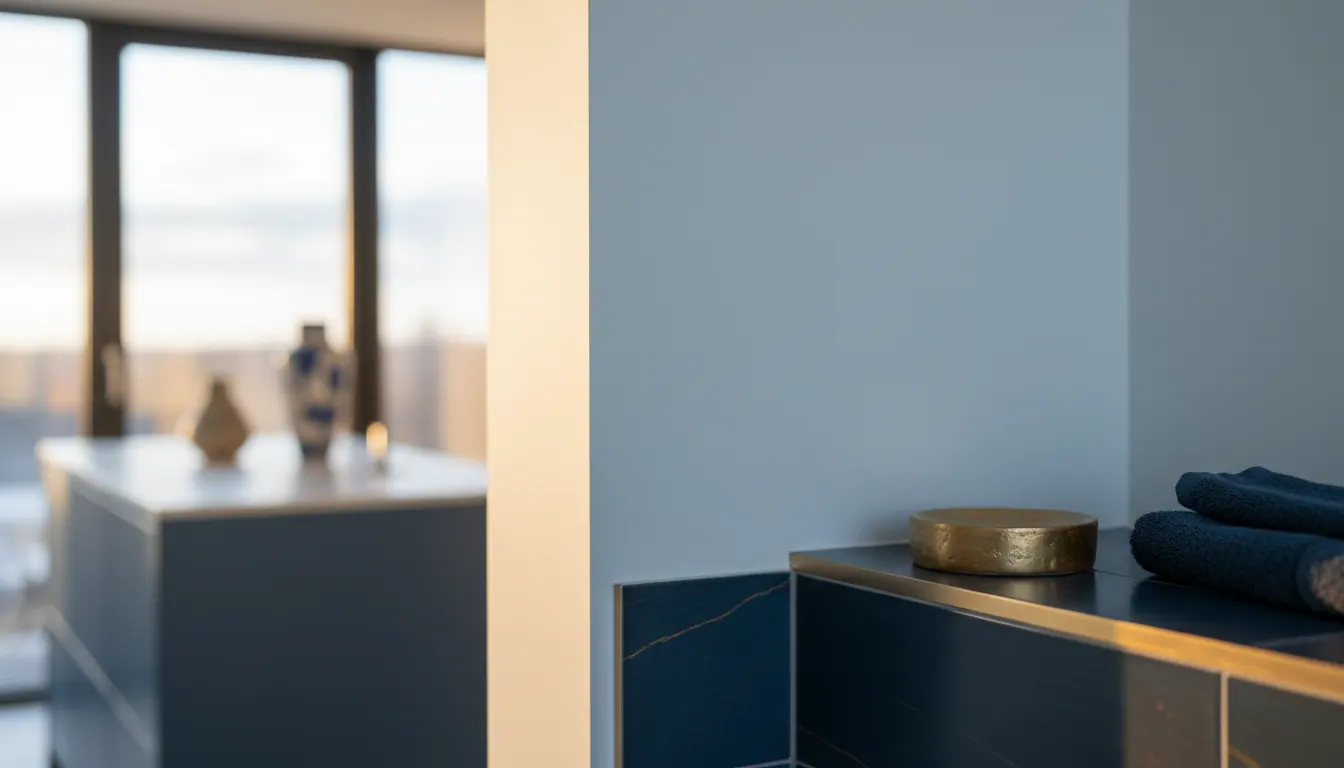
A mitred corner is the cleaner alternative. Instead of butting two tiles together and covering the raw edge with a trim, we cut each tile at a 45-degree angle so the two faces meet flush at the corner. The result is a seamless, continuous surface with no break in the tile face, no trim and no visible raw edge. It looks sharp because it is sharp.
It's the same principle a joiner uses on a picture frame or a piece of architrave. The joint itself disappears into the design.
Why it makes a real difference in a finished bathroom
Tile trim strips, the silver or chrome L-shaped profiles you see everywhere, do a job. They protect a raw edge and they're quick to fit. But they interrupt the surface. In a room where you've spent money on good porcelain, a plastic or metal strip draws the eye and breaks the clean run of the tile.
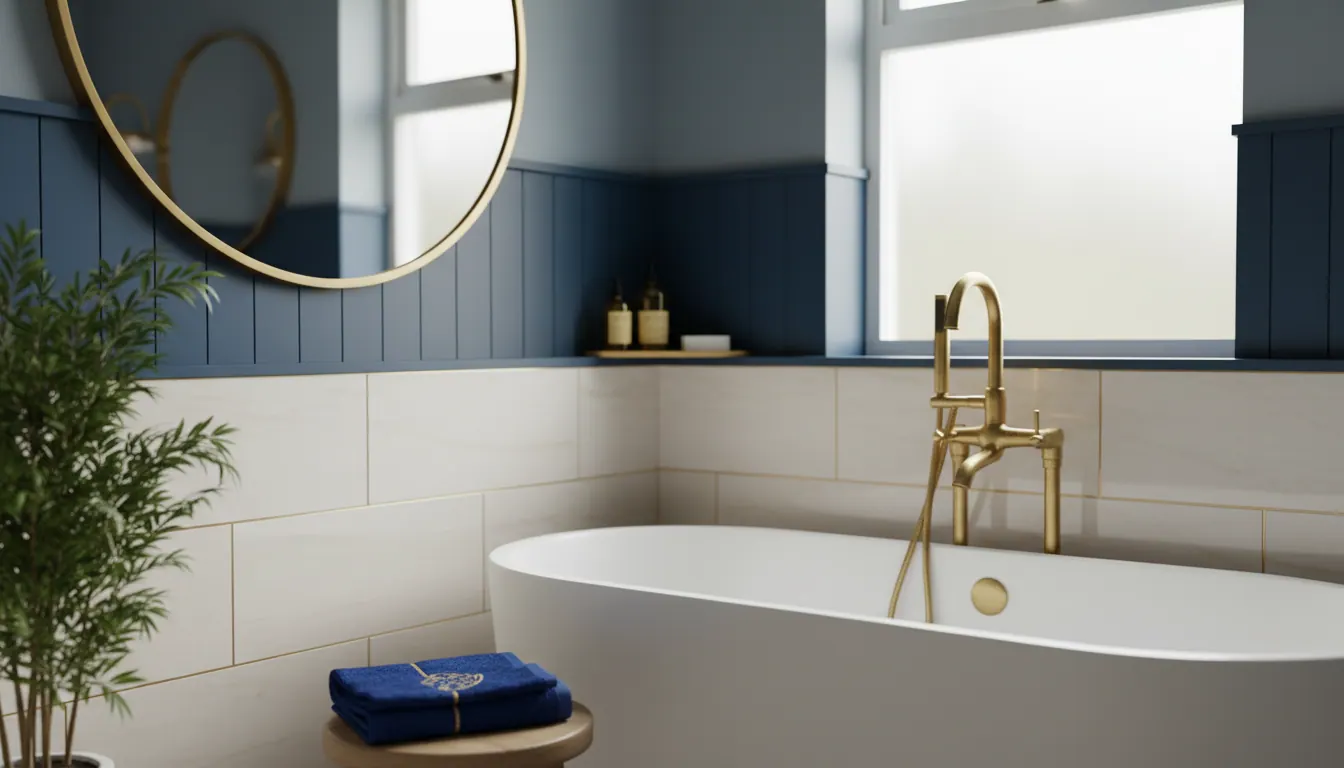
Mitred corners let the tile do the talking. If you've chosen a large-format stone-effect porcelain, a marble-look slab or even a bold patterned tile, a mitred edge keeps that visual flow going around the corner without a break. It's especially noticeable on shower enclosures, where external corners are often at eye level.
There's also a practical argument. Trim strips can collect soap scum, limescale and mould in the gap between the strip and the tile face. A well-executed mitre with a fine grout joint is far easier to keep clean.
The tools and skill involved
This is not a job for a standard tile cutter. Cutting a clean 45-degree bevel on porcelain, especially large-format porcelain, requires a wet saw with a tilting table or a dedicated angle grinder set-up, and it requires a steady hand and experience to get the angle consistent across every tile in a run.
The cut edge also needs polishing. A freshly cut porcelain edge is sharp and slightly rough. Before the tile goes up, that bevelled face needs to be smoothed with a diamond polishing pad so it sits cleanly against its partner tile and doesn't create a jagged line at the apex of the corner.
Getting the angle right matters more than people realise. If one tile is cut at 44 degrees and its partner at 46, the corner won't close properly. You'll see a gap at the face or a lip at the back. Over a full shower wall, those small errors compound. Every mitre joint needs to be cut and checked individually.
Where we use mitred corners on jobs across South Yorkshire
On most bathroom fits we carry out across Barnsley, Sheffield, Rotherham, Wombwell, Hoyland and the wider area, mitred corners come up in a few consistent places.
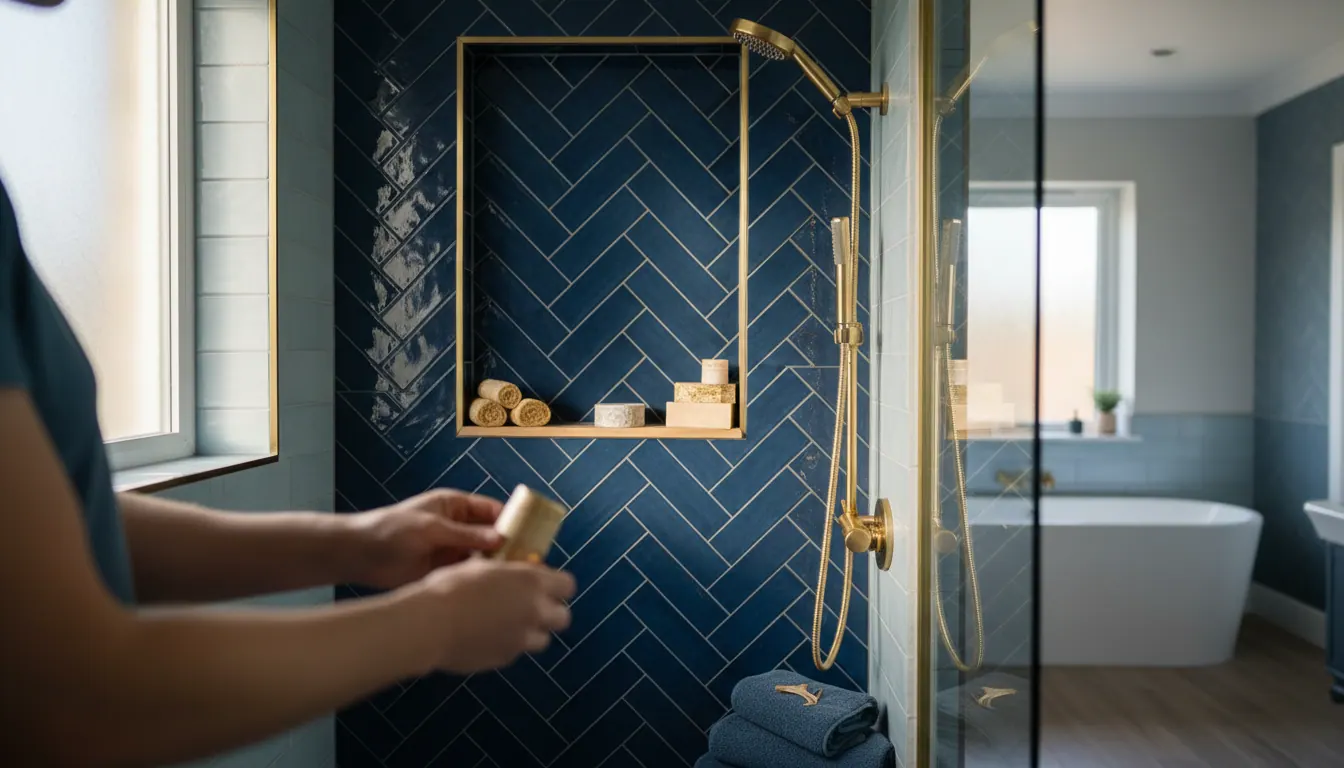
External shower corners. Any exposed corner on a tiled shower enclosure is a candidate. A trim here looks like an afterthought. A mitre looks intentional.
Feature wall returns. Where a feature tile or a different colour or texture wraps around a short return wall, a mitre keeps the transition clean rather than introducing a third material.
Window reveals. Tiling into a window reveal is common in older South Yorkshire housing stock, particularly in semi-detached and terraced homes where the bathroom window sits in a deep reveal. A mitred corner where the wall tile meets the reveal tile looks far better than a trim and is easier to seal properly.
Niche openings. If you're having a recessed niche built into your shower wall, the four external corners of that opening are natural places for mitred edges. It ties the niche into the overall tiling rather than making it look like an afterthought. We've written more about planning niches in our article on recessed tile niches in bathroom showers across South Yorkshire.
The prep that makes mitres possible
A mitred corner only looks good if the wall behind it is flat and plumb. If the wall bows or the corner isn't square, the two bevelled faces won't meet cleanly. You'll see a twist in the joint or a gap that opens up partway along the corner.
This is why the prep stage matters so much. On a full bathroom refit, we re-board the walls before tiling, which gives us a flat, stable substrate to work from. If the corner itself isn't plumb, we address that before the tiles go up, not after.
It's the same reason we tank the floor and walls properly before tiling in wet areas. A mitre joint on a shower corner that's moving or damp will fail eventually, no matter how well the cut was made. The finish is only as good as what's underneath it. If you want to understand more about what goes into that substrate work, our article on bathroom tanking and floor prep in Rotherham and Wombwell covers the detail.
What Sandra said
We get a lot of repeat enquiries from people who've seen work we've done for a neighbour or a family member, which tells us the finish is holding up in real homes.
Great work from P&M Home Improvements, very professional, friendly and thorough, would recommend for any home improvement
Sandra Hirst, 5 stars
That word "thorough" is the one we'd pick out. Mitred corners are a good example of where thoroughness shows. It's not a shortcut. It takes longer than fitting a trim strip. But it's the right way to do it, and it's the kind of detail that's still looking good five years later.
When trim strips are still the right call
It's worth being honest here. Mitres are not always the answer.
On very small mosaic tiles or heavily textured surfaces, a mitre is impractical. The bevel is too small to cut cleanly and the texture means the joint won't close. In those cases, a well-chosen trim in a matching finish is the right choice.
On budget-led jobs where the tile itself is quite thin, the bevelled face after cutting can be very narrow and fragile. Again, a trim may serve better.
We'll always tell you which approach suits the tile you've chosen and the layout you're going for. That's part of the conversation we have before anything gets ordered or cut.
Frequently asked questions
Can mitred tile corners be done on any tile? Most porcelain and ceramic tiles can be mitred, but the result depends on the tile's thickness and density. Thick, dense porcelain tiles, the kind used in large-format work, mitre very well. Very thin tiles or highly textured surfaces are harder to cut cleanly at 45 degrees. When you're choosing tiles, it's worth asking us whether your shortlisted options are suitable for mitred corners before you commit.
Do mitred corners need special grout or sealant? The joint at a mitred corner is grouted in the same way as any other grout joint, using a matching or contrasting grout depending on the design. In wet areas such as shower enclosures, the corner joint is also sealed with a flexible silicone. This is standard practice for any external corner in a wet room, mitred or not, because a rigid grout joint in a corner will crack over time as the building moves slightly.
Is it worth asking for mitred corners in a bathroom in Barnsley or Sheffield? If you're investing in a full bathroom refit and you're using large-format or good-quality porcelain tiles, mitred corners are worth specifying from the start. They affect how the tiles need to be ordered (you need to account for the material lost in the bevel cut) and how the job is planned. Mentioning it at the quote stage means we can factor it in properly rather than retrofitting the decision halfway through.
What's the difference between a mitred corner and a pencil-round edge? A pencil-round or bullnose tile has one factory-finished rounded edge, designed to sit at the end of a run and show a neat curved profile. It's a different approach to the same problem. Bullnose works well on smaller tiles and in certain styles. Mitred corners suit large-format porcelain and contemporary layouts better because they maintain the flat, continuous surface of the tile face. The two techniques aren't interchangeable, and the right choice depends on the tile and the look you're going for.
If you're planning a bathroom refit across Barnsley, Sheffield, Rotherham, Hoyland, Penistone, Dodworth, Darfield, Wombwell or anywhere else in South Yorkshire and you want to talk through the tiling detail, including whether mitred corners are right for your layout, give us a call. We'll come out, have a look at what you've got and give you a straight answer. No charge for the visit or the advice.
“Love my new kitchen! The guys were very professional and did a fantastic job. Well worth the money. Would highly recommend these guys.”