LVT Flooring vs. Ceramic Tiles in Wet Rooms Across South Yorkshire: Which Lasts Longer and Why
Thinking about LVT flooring for your wet room in South Yorkshire? We explain why it works, what can go wrong and how we fit it properly.
LVT Flooring in a Wet Room: The Short Answer
Luxury vinyl tile flooring has become one of the most popular choices for wet rooms across South Yorkshire, and for good reason. It handles water well, it's comfortable underfoot, it looks the part and it comes in a huge range of finishes. But fitting it in a wet room is not the same as laying it in a hallway or kitchen. Get the prep wrong and even the best LVT will fail.
We fit LVT in wet rooms regularly across Barnsley, Sheffield, Rotherham, Wombwell, Hoyland and the surrounding villages. Here is what we have learned about what works, what does not and why the floor underneath the LVT matters just as much as the LVT itself.
Can You Actually Use LVT Flooring in a Wet Room?
Yes, with the right product and the right installation method. Not all LVT is the same. Sheet vinyl is one thing, click LVT is another, and loose-lay or glued LVT is another again. In a true wet room, where the floor is designed to get wet and drain, a glued-down LVT is nearly always the right call.
Click LVT has a floating floor system with joints that lock together. In a wet room, water can track down through those joints over time, particularly around the drain and near the shower area. Once moisture gets beneath a floating floor, you have a problem: the subfloor can degrade, mould can develop and the floor will lift. We have stripped out more than a few wet rooms in Barnsley and Sheffield where a previous fitter used click LVT and the floor had to come back up within a couple of years.
Glued-down LVT eliminates that path for water. Every tile or plank is bonded to the subfloor, so there is nowhere for moisture to go except down the drain, which is exactly where it should go.
The Prep Underneath Is Everything
This is the bit that separates a wet room floor that lasts from one that does not.
In a proper wet room installation, the floor has to fall towards the drain. That fall is typically around 1 in 80 to 1 in 100, enough for water to run off reliably without feeling like you are standing on a slope. Getting those falls right means building them into the screed or the floor former before a single tile or piece of LVT goes down.
We also tank the floor. Tanking means applying a waterproof membrane to the floor (and up the walls to a height above the splash zone) so that any water that does get underneath the surface covering cannot reach the structural floor. LVT is water-resistant on its face, but it is not a waterproofing layer on its own. You need proper tanking beneath it.
The floor surface also has to be flat. LVT will telegraph any lumps, ridges or dips in the subfloor straight through to the surface. On older South Yorkshire housing stock, particularly the Victorian terraces and Edwardian semis you find across Barnsley and Sheffield, the existing floorboards are rarely flat enough. We typically re-board with a suitable sheet material, allow it to settle, then skim with a self-levelling compound before the LVT goes down.
For more detail on why this stage matters so much, our article on bathroom tanking and floor prep in Rotherham and Wombwell covers the whole process from the ground up.
What Are the Downsides of LVT in a Wet Room?
It is worth being straight about this. LVT is not perfect for every situation.
It can be damaged by sharp point loads. Dropping something heavy with a narrow base, a stiletto heel on a loose piece, or dragging furniture across it, can dent or gouge the surface. In a wet room this is rarely a big issue day to day, but it is worth knowing.
It is not as hard as porcelain tile. If you want a floor that will genuinely last decades without showing wear, large-format porcelain is harder to beat. LVT is tough, but it is a softer material.
It needs a very flat subfloor. As above. If the prep is rushed, the LVT will show every imperfection beneath it and the glue bond will be uneven, leading to edges lifting over time.
The quality varies enormously. Wear layer thickness is the number to look at. A thin wear layer will scuff and dull quickly in a busy bathroom. For a wet room, we recommend a wear layer of at least 0.5mm, and for a family bathroom with regular use, thicker still.
None of these are reasons to avoid LVT. They are reasons to choose it carefully and fit it properly.
Why We Recommend LVT for Many Wet Rooms
Despite those caveats, LVT genuinely suits a lot of the wet rooms we fit across South Yorkshire.
It is warm underfoot compared to porcelain, which matters in a bathroom first thing in the morning. It works well over underfloor heating. It is quieter to walk on. And the range of finishes available now is impressive: stone effects, wood effects, concrete effects, all in formats that suit modern and traditional bathrooms alike.
For households with young children or older family members, the slight give in LVT underfoot is a real practical advantage over hard tile. It is also easier to cut around awkward shapes, drains and wall junctions without the risk of cracking that comes with porcelain.
What a Full Wet Room Fit Looks Like When We Do It
A wet room is not just a shower tray swap. When we fit a wet room, the process typically runs like this:
- Strip back to bare walls and floor
- Re-board the floor if needed
- Lower the ceiling and fit recessed spotlights
- First fix for plumbing
- Tank walls and floor, including the drain area
- Build falls into the floor
- Tile walls (floor to ceiling in most cases)
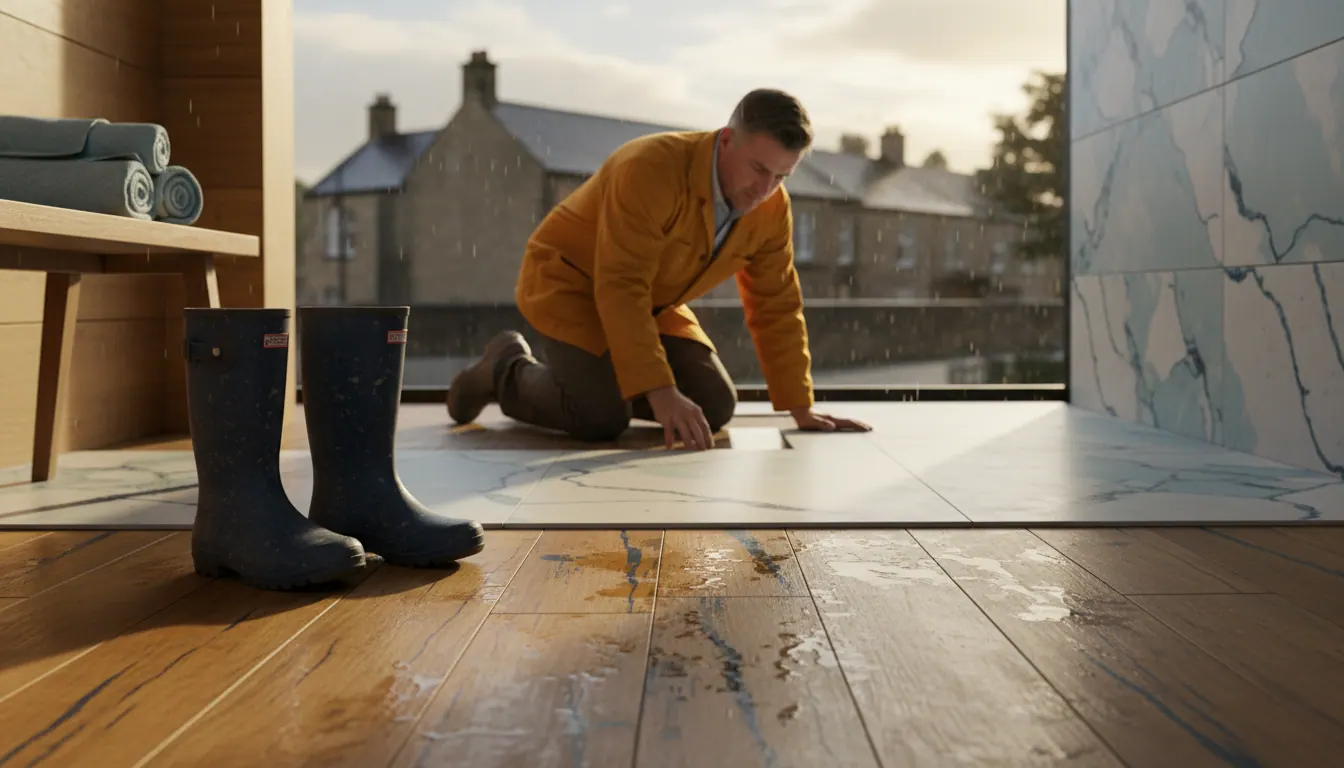
- Lay and glue LVT to the floor, cutting neatly around the drain
- Fit sanitaryware, screens and accessories
- Snag and clean
The LVT goes in towards the end, after the tiling is done and the walls are finished. That sequence matters: it protects the floor during the messy stages and means the LVT is not being walked on constantly during the build.
Shelayne Keeton, who has had us back for multiple phases of work, put it well:
Had Paul & Malcolm for our 3rd lot of home improvements, fantastic from start to finish. Full of great ideas & not afraid to share their knowledge & ideas with you! Will be booking for phase 3 & 4 of our home improvement very soon! Thanks guys look forward to seeing you again soon
That kind of repeat work tells us the approach is right. When the prep is done properly and the sequence is followed, the finished room looks good and stays that way.
LVT Alongside Tiling: Getting the Junction Right
One detail that catches people out is the junction between the tiled walls and the LVT floor. In a wet room, that junction is in the splash zone. If it is not sealed correctly, water will find its way in.
We use a flexible silicone bead at the tile-to-floor junction rather than rigid grout. Grout will crack as the building moves slightly with temperature and seasonal changes, particularly in older South Yorkshire homes. Silicone stays flexible and keeps the joint watertight.
The LVT itself butts up to the wall tile neatly. If the tiling has been done well, with straight, plumb lines and consistent grout joints, the LVT junction looks clean and intentional. If the tiling is out, it will show. Another reason why the whole job needs to be approached as one sequence rather than a series of separate tasks.
If you are thinking about the tile side of a wet room fit, our article on recessed tile niches in bathroom showers across South Yorkshire is worth a read for planning purposes.
Frequently Asked Questions
Can you use LVT flooring in a wet room? Yes, provided you use a glued-down product rather than a click-lock floating floor, and provided the subfloor is properly tanked, flat and built with the correct falls to the drain. Click LVT is not suitable for a true wet room because water can penetrate the joints over time.
What is the best flooring for a wet room? It depends on the household. Large-format porcelain tile is the most durable and hardest-wearing option. Glued LVT is warmer underfoot, easier on the joints and works well over underfloor heating. Both can work brilliantly in a South Yorkshire wet room if the prep underneath is done correctly. We talk through the options with every customer before we quote.
What is the downside of LVT flooring in a wet room? The main risks are using the wrong type (click rather than glued), fitting it over a poorly prepared subfloor, or choosing a product with a thin wear layer that will dull quickly. Done properly, with the right product and correct installation, LVT is a reliable and practical wet room floor.
Do you need to tank under LVT in a wet room? Yes. LVT is water-resistant on its surface but it is not a waterproofing membrane. The floor and walls in a wet room need to be properly tanked before any floor covering goes down. Skipping this step is one of the most common reasons wet rooms fail within a few years.
Ready to Talk About Your Wet Room Floor?
If you are planning a wet room in Barnsley, Sheffield, Rotherham, Hoyland, Penistone, Dodworth, Darfield or anywhere across South Yorkshire, we are happy to come and have a look and give you a free quote. Between us we have over 60 years of experience in the building trade, and wet rooms are some of the most satisfying work we do.
Call us on 07817 465504 and we will talk you through what is involved.